
Carbide-Armored Hybrid Components & Guide Rails: Heavy-Duty Structural Armor
Description
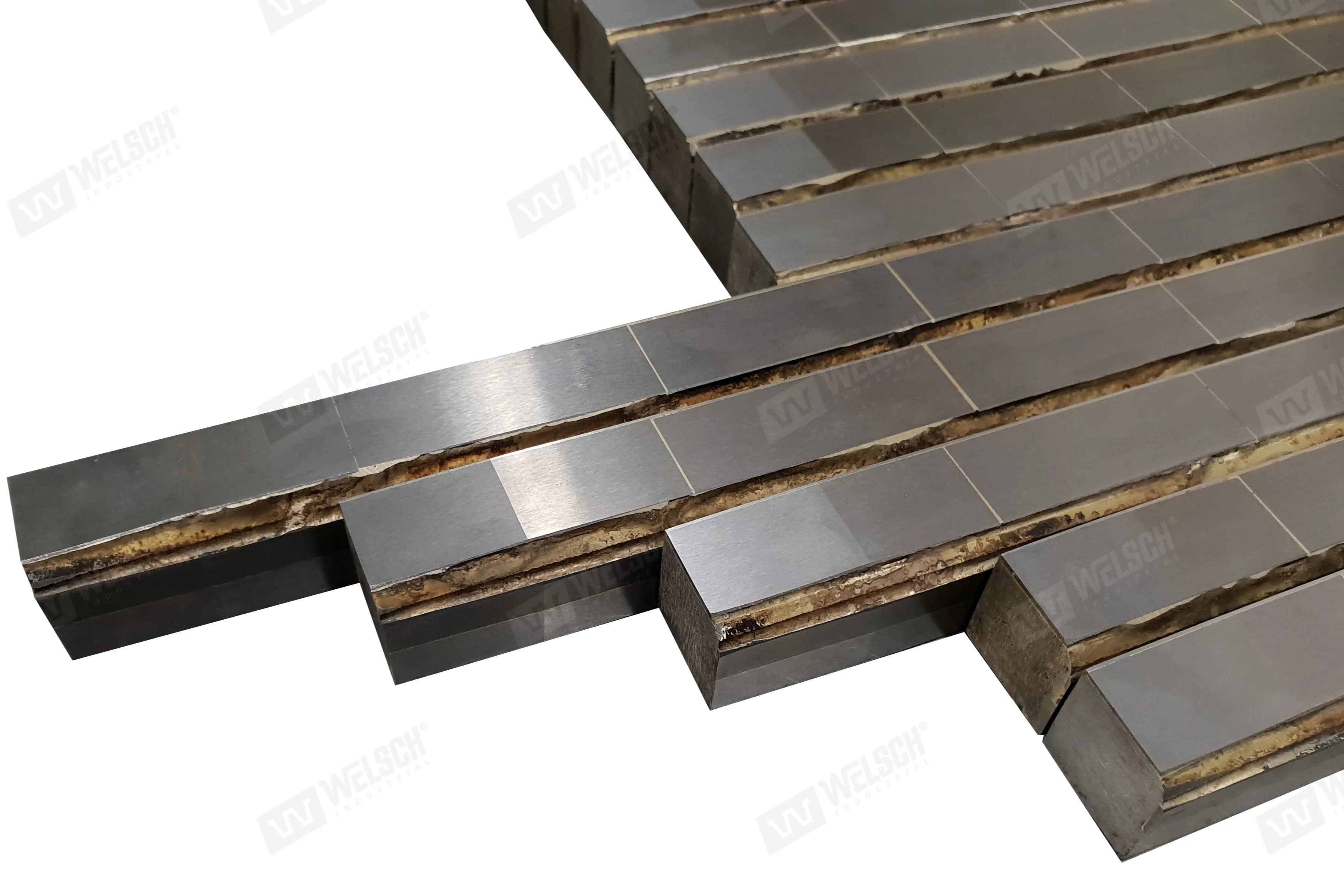
While solid tungsten carbide is ideal for smaller tools and specific geometries, larger machine elements, such as high-precision Guide Rails, Machine Beds, and heavy-duty Intake Liners, require the intense structural toughness and flexibility of engineering steel combined with the extreme surface hardness of hard metal.
WELSCH specializes in the engineering and physical fabrication of Hybrid Composite Assemblies. We integrate high-performance carbide bars, segments, and blocks onto precision-machined steel carriers to create an armored operational surface that is virtually impervious to severe mechanical abrasion and heavy surface friction.
The integrity of a hybrid component depends entirely on the joint between the carbide segment and the steel carrier. We deploy three distinct, field-proven joining methodologies, surgically selected based on the exact thermal, physical, and mechanical loads of your specific cross-industry application:
High-Strength Vacuum Brazing: Ideal for internal liner assemblies and high-speed feed systems, providing a seamless, heat-resistant, and high-integrity metallurgical bond engineered to handle intense, continuous high-frequency vibration.
Structural Cold-Bonding (Bespoke Polymer Gluing): Utilizing advanced high-performance industrial polymers to bond specialized carbide matrices to steel bodies in applications where any form of thermal distortion must be avoided, guaranteeing absolute micro-flatness across extensive machine frames and foundations.
Precision Mechanical Fastening (Countersunk Screwing): Tailored for high-impact zones subject to extreme mechanical shocks. We utilize custom countersunk screwing methods that lock the armor in place while allowing for the individual, rapid replacement of single carbide segments during regular plant maintenance cycles.
Advanced Grain Size Classification & Wear Matching Matrix:
To ensure your hybrid components match the exact abrasive profile and structural loads of your process, we customize the carbide segments according to the strict international recommendations of the Powder Metallurgy Association (classification, grain size, WELSCH grades / ISO category):
- Nano:
- < 0.2 µm
- Ultrafine:
- 0.2 to 0.5 µm (K06-K30)
- Submicron:
- 0.5 to 0.8 µm (K10-K50)
- Fine:
- 0.8 to 1.3 µm (K10-K50)
- Medium:
- 1.3 to 2.5 µm (K06-K60 / G05-G40)
- Coarse:
- 2.5 to 6 µm (K70 / G50-G55)
- Extracoarse:
- > 6 µm (B10-B45)
- Others:
- On request
Optimized Cross-Industry Hybrid Structural Elements:
Our hybrid manufacturing workflows provide Calculated Certainty for the core structural assemblies that define your production line's overall accuracy:
Carbide-Lined Guide Rails & Wear Strips: Maintaining a sub-micron friction surface for continuous high-speed material travel, extending your standard maintenance intervals by up to 10x compared to conventional hardened steel rails.
Reinforced Machine Beds & Foundations: Engineering ultra-flat, fully armored foundations that reliably withstand the constant compression, friction, and shifting weights of heavy industrial processes.
Precision Material Intake & Throat Liners: Armoring the high-friction feed zones where raw industrial aggregates or abrasive materials enter the machine, ensuring constant volumetric material flow and permanently reduced friction.
By combining our advanced multi-axis and 5-axis CNC milling expertise with specialized metallurgy and carbide joining, WELSCH delivers ready-to-install hybrid components that are perfectly balanced. We manage the entire manufacturing cycle in-house: from the initial 3D machining of the heavy steel body to the final precision diamond grinding of the permanently joined carbide face. The result is a hybrid industrial asset that offers the surgical precision of a brand-new machine part with the legendary, friction-defying lifespan of tungsten carbide.
The WELSCH Value Proposition: We replace high-wear mechanical liabilities with armored structural certainty. Through advanced Vacuum Brazing, structural bonding, and precision engineering, we deliver cross-industry hybrid components that safeguard your CAPEX, prevent structural deflection, and deliver the lowest possible Total Cost of Ownership (TCO) on your shop floor.
Technical Features
- Carbide bars, segments and blocks joined to precision-machined steel carriers
- Three joining methods: vacuum brazing, structural cold-bonding and countersunk screwing
- Carbide-lined guide rails with up to 10x longer maintenance intervals than hardened steel
- Ultra-flat, fully armored machine beds and foundations
- Armored intake and throat liners for constant volumetric material flow
- Complete in-house cycle from 3D steel machining to final diamond grinding
These products are customized solutions tailored precisely to your individual requirements. Contact us for personal consultation.
Frequently Asked Questions
Have Questions?
Our team of experts will be happy to advise you on this product.
At a Glance
- Custom manufacturing
- Made in Germany
- Worldwide shipping
- Technical support
More Products
- Custom Special Machinery & Fixture Building: Rugged, Honest, and Engineered for High-Yield Performance
- Solid Tungsten Carbide Tools & Semi-Finished Materials: The Pinnacle of Powder-Metallurgy
- Defense-Grade Swiss Turning & Small Precision Parts: Zero-Clearance Mechanical Stability
- 5-Axis 3D Freeform Milling & Tool Inserts: Architectural Precision in High-Strength Alloys
- Long-Format Linear Technology & Flat Steel Machining: Macro-Scale Lengths & Surgical Timing